Finding · Squirrels
Scratching at dawn: squirrels out, soffits closed
Scrabbling in the ceiling just after sunrise, gnawed fascia, a hole at the roof corner. Resolve traps the squirrels and seals the entry points.
Chapter 01
Scrabbling at sunrise, gnawed wood, a hole at the roof corner
Squirrels work the day shift. If the noise in the ceiling starts at sunrise and fades by late morning, it is almost never a mouse. Other signs are a gnawed fascia board, a hole at the corner of the roofline, a chewed vent cover and acorn shells in the attic insulation. Gray squirrels are the usual culprits, though flying squirrels and chipmunks sometimes share the space.
Gray squirrels chew to widen openings and chew wires when they are inside. Attics in Howell, Marlboro and Holmdel with overhanging oaks are particularly exposed, because branches give a straight road onto the roof. Left alone, one animal turns into a nest with young by spring. In winter they hoard, in spring they nest and in all seasons they chew, so no month is quiet.
Chewed wiring is the reason to act sooner rather than later. Insulation stripped back from a cable, a burnt smell near the attic hatch or flickering lights in one room are all worth reporting, and the technician will note them for an electrician. Wiring is the costly part of squirrel damage, so a prompt call protects more than the attic.
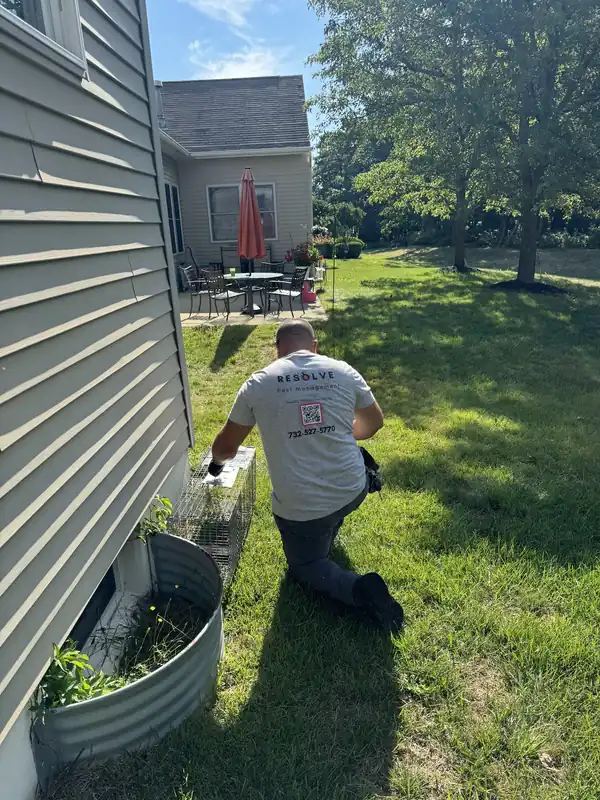
Resolve technician kneeling at a live-catch trap beside a house foundation
Roof edge to attic: finding every opening, then the trap
The visit starts at the roofline. The technician looks at soffit returns, gable vents, fascia corners, chimney flashing and the branches that lead there, because squirrels rarely use only one hole. Squirrel removal is part of Resolve's wildlife work of trapping and removal, using live-catch traps placed where the animals travel. The technician walks you through each point and explains what the animal has been doing there.
Traps are set at the active entry and checked on a schedule. Nothing is left sitting for days, and you are told when the next check is due. If young are present, the plan accounts for them before anything is closed up. That timetable is yours to hold the crew to, and any change is explained by phone. A trap in the sun or the rain is checked sooner than one in a sheltered spot.
Once the animals are out, every opening is sealed with materials a squirrel cannot chew through, which is the part of the job that holds up over time. A patch of foam or a bit of wood does not last a week, and the technician explains why each repair was chosen. The repairs are small but exact, and the technician points to each one before leaving, so you can see what was done.
Chapter 03
Branch trimming, the spring litter, and when to ring again
Prevention after removal is mostly geometry. Trim branches back several feet from the roof, check the sealed corners after a storm, and listen for scratching at sunrise in late winter and early spring, when females look for nesting sites. A neighbor's trees count too, so a friendly word over the fence can help, and the technician can say which branches matter most. Late winter is the season to look.
A bird feeder hung near the house works as an invitation, so move it well out into the yard. Squirrels can jump surprising distances, and the closer the feeder, the shorter the leap to your roof. A bird feeder is the single most common reason a squirrel finds a roof, and it is easy to correct. Place it well away from any branch or ledge a squirrel could use.
If you hear them again and you are not satisfied, the 100% satisfaction guarantee brings Resolve back to retreat at no additional cost. Freehold, Manalapan and Red Bank homeowners can call (732) 527-5770 at any hour. Family owned, licensed and insured under NJ LIC# 91689B. The crew is local, based in Bayville, and serves Ocean, Monmouth and Burlington counties.
Every roofline opening found, trapped out, sealed against chewing.
CROSS-REFERENCE · NJ LIC# 91689B